
Longevity Supplements: Why We Don’t Mix Everything Into One Capsule – And Why That’s Better for You


If you’re between 40 and 70 and interested in healthy aging, you’ve probably felt the appeal of simplification. Fewer bottles, fewer pills, one neat capsule that handles your NMN, resveratrol, spermidine, omega 3 fatty acids, vitamin D, and maybe collagen for good measure. The rise of the 'popular supplement' trend—where ingredients like creatine and NAD+ have become widely accepted for their proven benefits in muscle building and healthy aging—shows just how much people value effective, science-backed options. The supplement industry has noticed this desire, and since around 2020, “all-in-one” longevity blends have flooded the market—each promising to support cellular health, brain health, skin, joints, and cardiovascular health in a single daily dose. Many people may need extra help from supplements to fill nutritional gaps due to modern life and stress.
Here’s the problem: combining everything into one capsule often backfires.
At Vitruvin, we deliberately avoid putting every longevity ingredient into one mega-capsule. This isn’t about selling more products—it’s about respecting the science of how these compounds actually work. Dosing requirements vary wildly. Some ingredients compete for absorption. Others need different timing to be effective. And cramming them all together often means none of them work as well as they should.
In this article, we’ll walk through how longevity supplements function, what goes wrong inside mega-blends, and why targeted, modular stacks are typically better for your overall health and your results. By the end, you’ll understand why the slightly more complex approach of separate, focused supplements often delivers what one giant pill cannot.

The Foundations of Longevity Supplementation (In Plain English)
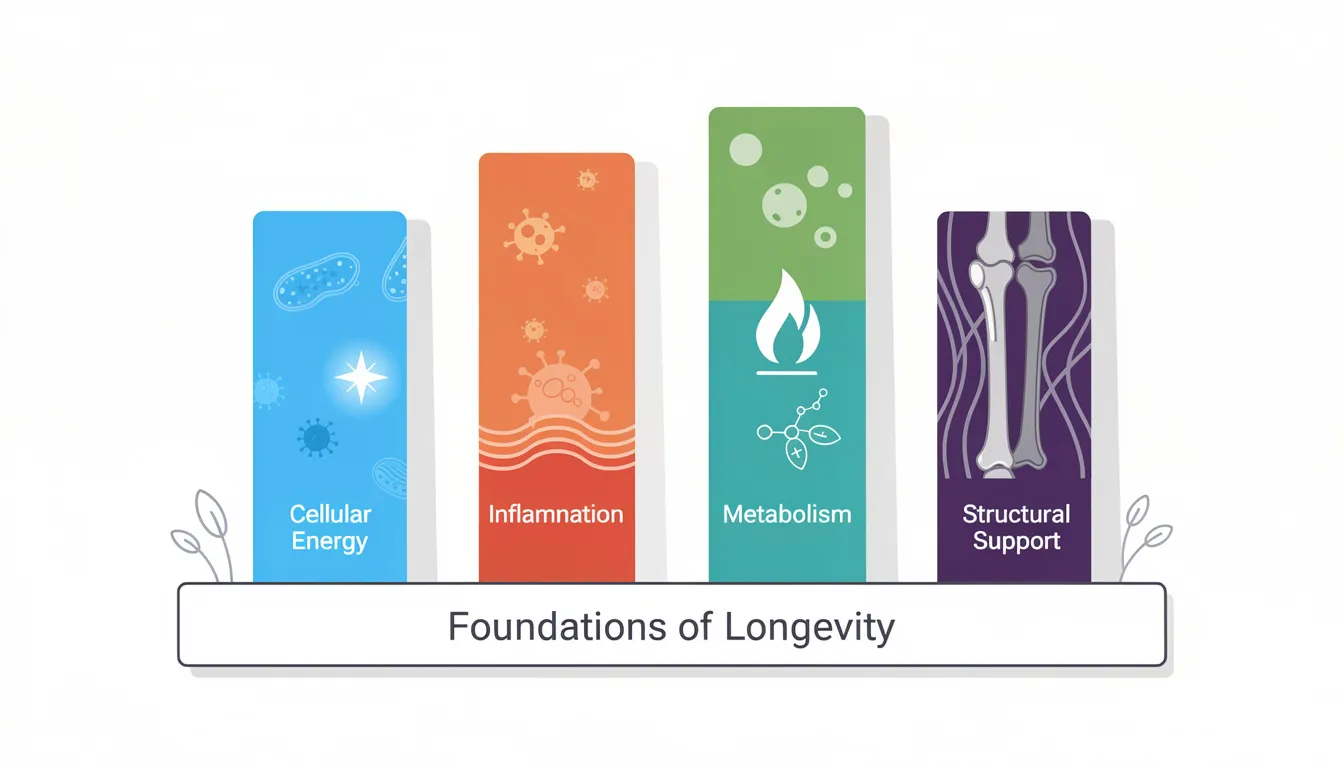
Most longevity supplements work through a handful of core biological themes: cellular energy production, inflammation management, metabolic health, and structural support. Understanding these basics helps explain why certain ingredients don’t belong in the same capsule. A comprehensive longevity strategy often involves taking several supplements, each designed to target a specific aspect of healthy aging.
Cellular Energy and NAD⁺
Your cells run on energy, and that energy production depends heavily on a molecule called NAD⁺. As we age, NAD⁺ levels decline, which affects mitochondrial function and cellular energy. NAD⁺-boosting compounds like NMN (nicotinamide mononucleotide) and NR (nicotinamide riboside) have been studied in human trials between 2016 and 2022, showing potential for supporting energy metabolism and cellular function. These compounds aim to restore what your body can no longer naturally produce at youthful levels.
Cellular Stress and Senescence
Resveratrol, fisetin, quercetin, and green tea polyphenols are being researched for their effects on cellular stress and cellular senescence—the process where damaged cells stop dividing but don’t die. Most evidence comes from preclinical studies and a limited number of human trials, but the interest centers on how these polyphenols may influence aging pathways and support the body’s stress response at the cellular level.
Autophagy and Cellular Cleanup
Spermidine has gained attention for its role in autophagy—essentially your cells’ internal cleanup and recycling system. Human observational and small intervention studies from 2018 to 2023 have examined spermidine’s relationship with cognitive performance and cardiovascular markers in older adults. The research suggests potential benefits for cognitive function and heart health, though studies remain ongoing.
Structural Support Nutrients
Marine collagen and vitamin C support skin and joint health by providing amino acid building blocks for connective tissue. Omega 3s and vitamin D contribute to bone health, joint health, and cardiovascular health. Magnesium, an essential mineral, is also crucial to the body's functioning and may help prevent chronic inflammation that can lead to age-related diseases. These nutrients support your body’s structures rather than “reversing” the aging process—an important distinction that keeps expectations realistic.
The science is evolving. These compounds may support healthy aging trajectories, but they are not cures or guarantees against specific diseases. What matters for our discussion is that each of these categories has different requirements for dosing, absorption, and timing—which brings us to the core problem with all-in-one formulations.
Why “Everything in One Capsule” Sounds Great but Fails in Practice
Imagine you’re a 55-year-old trying to simplify your routine. You currently take NMN, resveratrol, spermidine, lion’s mane, magnesium, omega 3s, vitamin D3 with K2, and marine collagen. That’s eight different supplements. The appeal of combining them into one daily pill is obvious.
The problem is physics.
The Hard Limits of Capsule Size
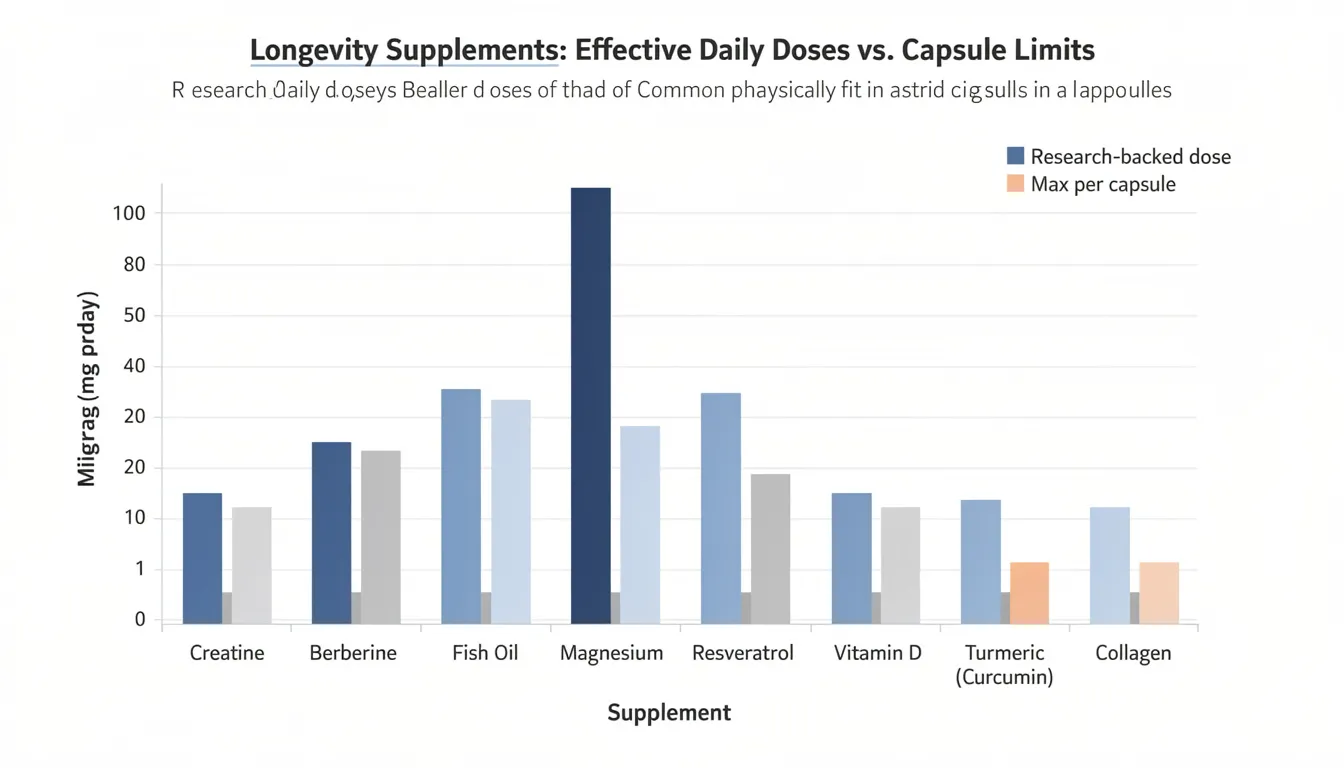
A standard 00 capsule—one of the larger sizes most people can comfortably swallow—holds approximately 400 to 1000 milligrams of powder, depending on ingredient density. Now consider what clinical research actually uses for effective doses.
Omega 3 EPA and DHA studies typically use 1 to 2 grams per day for meaningful cardiovascular health and brain function benefits. A single 00 capsule can hold only a fraction of that. Marine collagen research on skin and joint health uses 2.5 to 10 grams per day—literally impossible to fit in one small capsule. Lion’s mane for cognitive function often appears in studies at 500 to 1000 milligrams taken one to three times daily. And that’s before adding NMN, resveratrol, vitamin D, magnesium, and everything else.
The math simply doesn’t work.
The Formulation Trade-Offs
To keep an “all-in-one” capsule small and affordable, manufacturers face uncomfortable choices. They can underdose key ingredients to fit everything in. They can substitute cheaper, less bioavailable forms of nutrients. Or they can include token amounts of popular ingredients—just enough for label appeal, not enough for actual benefit.
When you see a capsule claiming to contain 15 different longevity actives, ask yourself: at what doses? If a product contains 50 milligrams of marine collagen when studies use 5,000 milligrams, that ingredient is there for marketing, not for your health span.
Regulatory and Safety Constraints
Combining many bioactive compounds increases unknown interaction possibilities. Responsible formulators must therefore keep individual dosages conservative, which further weakens each ingredient’s impact. A 2024 clinical trial of a multi-ingredient longevity supplement (NOVOS Core, containing 12 compounds) showed promising vascular results, but as the reviewing vascular surgeon Dr. Christopher Yi noted, “it’s impossible to know which ingredients drove the effect.” This attribution problem haunts every mega-blend: when something works, you can’t identify why. When something doesn’t work—or causes problems—you can’t identify why either.
Scientific Reasons We Don’t Mix Certain Longevity Actives Together
Beyond the simple space constraints, certain compounds shouldn’t share a capsule due to how they’re absorbed, when they work best, and how they interact with your metabolism.
Absorption and Bioavailability
Fat-soluble nutrients like vitamin D, K2, CoQ10, and certain forms of curcumin absorb best when taken with dietary fats. These compounds need a fat-based delivery system or a meal containing healthy fats to reach your bloodstream effectively. Vitamin D is a fat soluble vitamin that requires this consideration for proper absorption.
Meanwhile, water-soluble compounds like NMN, vitamin C, and many polyphenols may work better when taken away from large fat loads for some individuals. And probiotic supplement strains can be sensitive to certain acids or botanicals when packed into tight blends, potentially reducing viable counts before the capsule even reaches your gut health system.
Research emphasizes that plant-derived longevity compounds “exist in a matrix that enhances absorption and biological impact” in their natural food sources. When extracted and combined artificially, they lose the supporting compounds that originally facilitated their effectiveness.
Timing and Circadian Considerations
Your body operates on rhythms. Stimulatory or energizing compounds—green tea extract, some adaptogens, NAD⁺ boosters that support cellular energy—are often best taken earlier in the day to avoid interfering with sleep.
Conversely, magnesium forms that support muscle and nerve function and relaxation, along with some mushroom extracts, may be preferred in the evening. If everything is combined into one morning or evening capsule, several ingredients will be taken at sub-optimal times.
You can’t support both energy production in the morning and relaxation at night with a single capsule taken once daily.
Shared Metabolic Pathways
NAD⁺ precursors such as NMN and niacin rely on methylation pathways for their metabolism. Stacking them with multiple other methyl-dependent ingredients in one high-dose capsule could theoretically stress methyl donors in susceptible individuals. As one expert noted, many people take TMG (trimethylglycine) specifically “to counter some of the negative consequences” of NAD⁺ precursors—but the optimal ratio varies by individual genetics and existing methyl status.
This isn’t about guaranteeing harm or benefit. It’s about recognizing that complex metabolic interactions call for cautious, separate dosing rather than throwing everything together.
Stability and Shelf Life
Some polyphenols, including resveratrol, are sensitive to light and oxygen. Mixing them with hygroscopic minerals or acidic botanicals in one capsule can accelerate degradation. By the time you finish the bottle, the resveratrol may have lost significant potency.
Probiotics face similar challenges. Moisture-attracting powders stored alongside probiotic strains often reduce viable bacterial counts significantly before the consumer even opens the product. Gut health benefits require live organisms—not degraded remnants.
Case Study Examples: What Goes Wrong Inside an “All-in-One” Longevity Capsule
Theory is useful, but concrete examples make the problems tangible. Let’s walk through realistic scenarios that illustrate why single-capsule mega-blends underperform.
Case Example 1: The NAD⁺ Stack
Consider a capsule combining NMN, NR (nicotinamide riboside), niacin, TMG, and methylated B vitamins. On paper, this looks comprehensive—covering multiple angles of NAD⁺ support and methylation.
In practice, individual needs vary enormously. Some users might only need 250 milligrams of NMN with minimal niacin. Others have genetic variations affecting methylation (revealed through testing) that change their TMG requirements. Some people experience niacin flushing at standard doses while others tolerate it easily.
An all-in-one formulation removes the flexibility to adjust. You get what’s in the capsule, whether or not it matches your biochemistry. Studies suggest that personalized approaches produce better results—but personalization is impossible when every ingredient is pre-mixed at fixed ratios.
Case Example 2: The Skin, Joints, Heart, and Vitamin D Blend
A hypothetical formulation combines marine collagen, vitamin C, omega 3s, astaxanthin, and hyaluronic acid. Each ingredient has legitimate research behind it for structural support, cardiovascular health, and skin quality.
The problem: effective collagen dosing requires grams, not milligrams. Omega 3 fatty acids need softgel delivery with a fat base to maintain stability and absorption. Fish oil cannot be effectively delivered as a dry powder alongside collagen and vitamins.
Squeezing these into one small capsule means drastically compromised dosages. You might get 100 milligrams of collagen instead of 5,000. You might get 50 milligrams of omega 3s instead of 1,500. The ingredients appear on the label, but the long term health benefits you’re seeking require doses the capsule physically cannot contain.
Case Example 3: The Brain Health and Mood Formula
An all-in-one brain health formula might include lion’s mane, magnesium L-threonate, green tea extract, and B-complex vitamins. Each supports cognitive function, mental health, or nerve function in some capacity.
But here’s the timing conflict: many people take magnesium at night to support relaxation and sleep quality. Green tea extract contains caffeine and other compounds that may provide unwanted stimulation if taken in the evening. Taking them together forces a choice—and either the relaxation benefits or the cognitive performance benefits get compromised.
The Control Problem
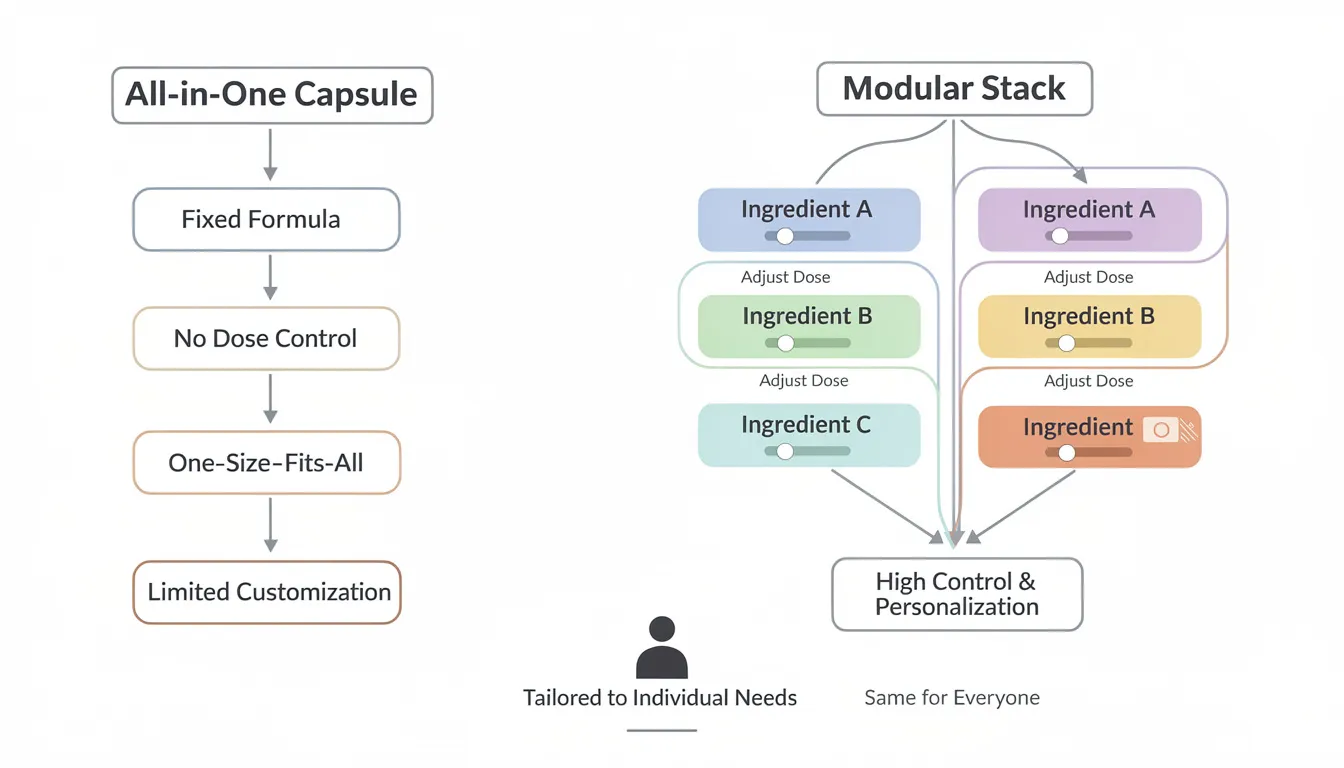
Separating these ingredients into targeted products provides control that mega-blends cannot offer. You can adjust dosages slowly based on how you respond. You can stop one component if you experience side effects without abandoning your entire supplement regimen. You can align timing with sleep, meals, and resistance training schedules.
That control matters. When clinical research emphasizes “reassessing and adjusting for time, dose, and frequency,” the advice assumes you can actually make those adjustments. Fixed-ratio capsules eliminate that possibility.
Why Separate, Targeted Capsules Can Be Better for You
Modular supplementation is like adjusting separate dials—cellular energy, cognitive function, joint comfort, skin quality—rather than pulling one giant lever and hoping everything moves in the right direction.
Customize Dosing to Your Needs
A 62-year-old focused on bone density and joint health might want higher marine collagen doses and lower amounts of stimulatory botanicals. A 45-year-old prioritizing energy metabolism and exercise performance might emphasize NMN and lion’s mane while keeping structural supplements minimal.
Using separate NMN, resveratrol, spermidine, marine collagen, and omega 3 products allows each person to tune amounts based on their health goals and, ideally, relevant lab markers. This personalization is what the research actually supports—not one-size-fits-all formulations that assume identical needs across all users.
Improve Tolerance and Safety
If you notice digestive upset, muscle pain, or headaches after starting a new supplement protocol, separate products let you pause one ingredient at a time to identify the cause. Stop the resveratrol for a week. See if symptoms resolve. If so, you’ve found your answer while continuing everything else.
In an all-in-one capsule, your only options are to stop everything or keep taking supplements despite discomfort. Neither supports your overall health effectively.
Align with Your Schedule
Thoughtful timing can enhance supplement effectiveness. NAD⁺ support and lion’s mane in the morning may support energy production and cognitive function during working hours. Magnesium and collagen later in the day align with relaxation and tissue repair during sleep. Vitamin D3 and K2 with your biggest meal (containing healthy fats like fatty fish or avocado) improves absorption.
These timing adjustments—which registered dietitians and longevity researchers recommend—are impossible with a single fixed capsule.
Support Better Testing and Feedback Loops
People using bloodwork to track vitamin D deficiency, cholesterol levels, omega 3 index, or biological age markers can tweak one variable at a time and observe clearer cause-and-effect relationships. If your vitamin D levels improve after adding a standalone D3+K2 supplement, you know what worked. If your omega 3 index rises after adding fish oil, that’s actionable data.
When you change multiple variables simultaneously—as you must with an all-in-one capsule—the feedback becomes noise. You can’t determine which ingredient drove improvement or which caused problems. Clinical research on the NOVOS Core trial explicitly acknowledged this limitation: improvement occurred, but attributing it to specific ingredients was impossible.

Designing a Smart, Modular Longevity Stack (Without Overcomplicating It)
You don’t need 20 products cluttering your counter. Most adults can start with a simple base and add carefully over several months. The goal is building a sustainable healthy lifestyle, not overwhelming yourself with complexity.
A Sample Framework (Not a Prescription)
Consider organizing your approach around functional categories.
Core daily fundamentals might include vitamin D3 with K2 (if testing reveals deficiency—common in northern latitudes and among older adults), omega 3s for cardiovascular disease risk reduction and brain function, and magnesium for muscle and nerve function.
Cellular support could involve an NAD⁺ booster like NMN plus resveratrol or another polyphenol, adjusted based on tolerance and response. These target cellular aging and energy metabolism at a fundamental level.
Structural support addresses the physical scaffolding of your body: marine collagen for skin and joint health, paired with vitamin C for collagen synthesis.
Cognitive and metabolic extras—lion’s mane for brain health, spermidine for autophagy support, green tea extract for anti inflammatory polyphenols—can be added based on specific health goals and how the basics are tolerated.
This approach reflects how Vitruvin designs products: single-focus or small, logical combinations rather than giant blends. Users can layer safely and adjust over time without being locked into fixed formulations.
A Step-by-Step Introduction
Weeks 1 through 4: Add only one or two basics. Perhaps vitamin D3 with K2 and magnesium. Track how you feel—sleep quality, energy, immune function, any digestive changes. A quality multivitamin can serve as a starting point, but targeted individual supplements often provide more appropriate doses.
Weeks 5 through 8: Introduce one cellular support supplement, such as NMN. Monitor sleep, daily dose of energy, exercise recovery, and any changes in how you feel. This is where you’re targeting cellular function and cellular energy production directly.
Weeks 9 through 12: Consider adding structural support like marine collagen and a polyphenol such as resveratrol. Note any changes in skin quality, joint comfort, or recovery from resistance training.
Beyond three months: Only consider additional agents—spermidine, mushroom extracts, additional anti aging supplements—if the basics are consistent and well-tolerated. Building gradually lets you identify what actually helps versus what adds complexity without benefit.
Practical Guidance for Success
Work with a clinician familiar with longevity research and clinical research on these compounds whenever possible. A healthcare provider can help interpret lab results and tailor recommendations to your situation.
Recheck key blood markers—vitamin D, B12, lipid panel, potentially inflammatory markers—every 6 to 12 months. These provide objective data on whether your supplement regimen is actually moving the needle on your health and longevity goals.
Be skeptical of dramatic claims. Look for taking supplements backed by published data on specific forms and dosages, transparent third-party testing, and clear labeling. A diet rich in leafy greens, fatty fish, and whole foods remains foundational—anti aging supplements complement a healthy diet, they don’t replace it.
The Core Message
Separating longevity supplements into thoughtful, science-informed components gives you more control, clearer feedback, and often better outcomes than stuffing everything into one capsule. The minor inconvenience of multiple bottles is vastly outweighed by the ability to personalize, adjust, and understand what’s actually working.
Stress management, sleep quality, resistance training, and a healthy lifestyle remain the foundation for a longer and healthier life. Supplements support these fundamentals—they don’t substitute for them. But when you do supplement, doing so intelligently matters.
Key Takeaways and Next Steps for Readers
Capsule size limits are real. One capsule cannot hold effective doses of popular longevity ingredients like NMN, resveratrol, spermidine, marine collagen, omega 3s, and lion’s mane without serious compromises in dosing.
Absorption and timing differ by ingredient. Separate products respect differences between fat-soluble and water-soluble compounds, morning versus evening timing, and potential interactions between NAD⁺ boosters and methylation pathways.
Modular stacks enable personalization. You and your practitioner can adjust individual doses, pause one ingredient at a time to troubleshoot issues, and align your protocol with lab results and how you actually feel.
Evidence is promising but evolving. Many longevity supplements show potential in clinical research, but they should complement—not replace—sleep, resistance training, nutrition, immune health practices, and stress management fundamentals.
Gradual, intentional building works better. A minimalist stack introduced slowly is typically safer, more sustainable, and more informative than a single complex “everything” pill that obscures cause and effect.
DNA repair, cognitive decline prevention, and healthier life outcomes require consistent, long-term approaches—not magic bullets in mega-capsules.
Your practical next step: List your current supplements. Identify which ingredients might be underdosed, redundant, or poorly timed. Then discuss a more targeted, modular plan with your healthcare provider. Building a supplement regimen that respects how these compounds actually work—rather than how marketing suggests they should—is the foundation for supporting your health span and achieving your health goals.
The best supplements for your situation aren’t necessarily the ones with the longest ingredient lists. They’re the ones that deliver meaningful doses of well-researched compounds in forms your body can actually use, taken at times that make biological sense. That’s the principle behind modular longevity supplementation—and why we don’t mix everything into one capsule.


Comments